Teachers must not be neutral: taking a professional stance is part of the job
What does it mean for teachers to take a professional stance on democracy? This question is becoming increasingly important in schools facing racism, discrimination, disinformation, and anti-democratic tendencies. In Germany, a broad alliance of education and civil society organisations is calling for stronger civic education and better support for teachers addressing these challenges.
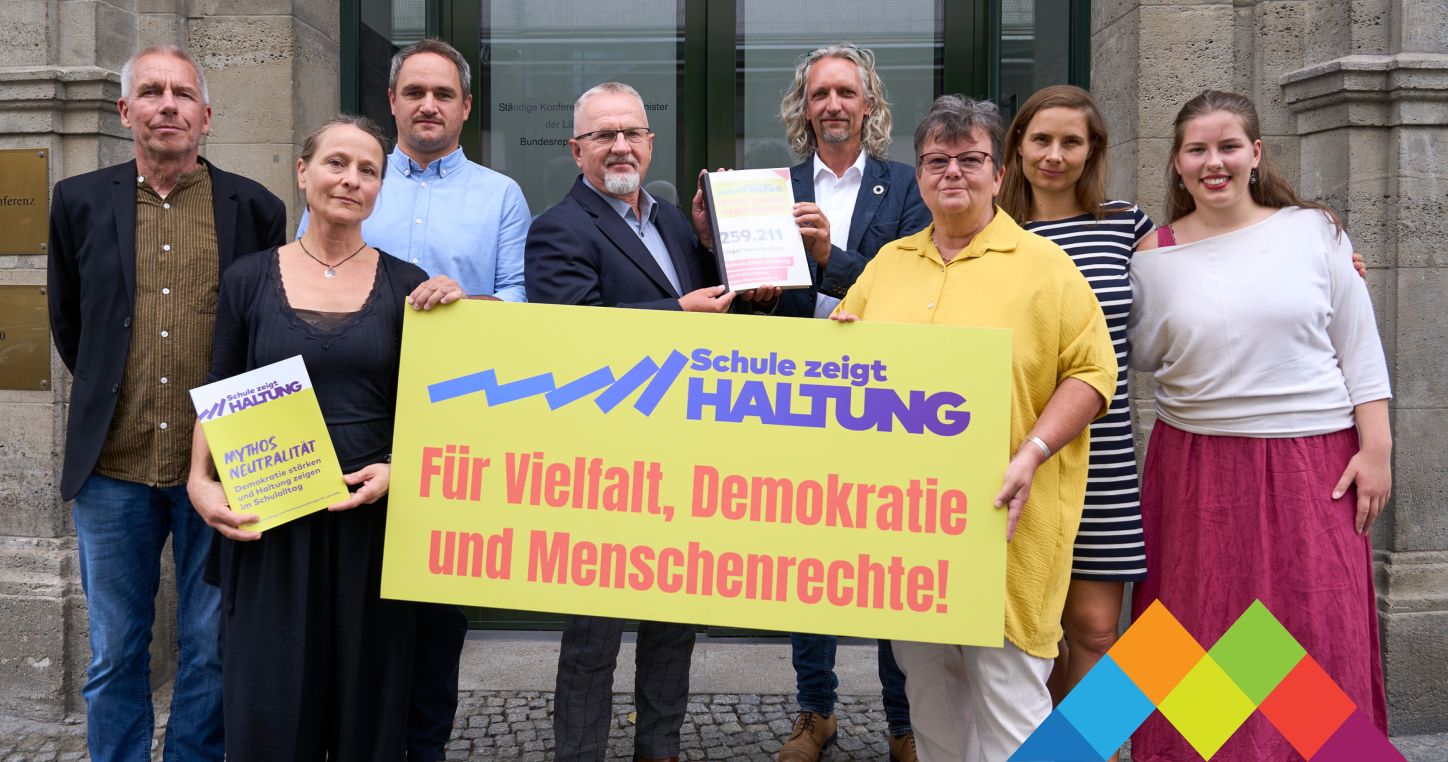
More than 260,000 people have signed the petition “Schule zeigt Haltung – Lehrkräfte stärken gegen Hass und Hetze”(“Schools take a stand – Strengthening teachers against hate and agitation”). Launched in November 2025 by the German Education Union (GEW), Greenpeace, Teachers for Future Germany, the Federal Student Conference, the German Association for Civic Education (DVPB), and Parents Against the Far Right, the petition calls for better conditions for teachers to uphold democratic principles in their daily work. In Berlin, representatives of the alliance have now handed the petition to the Secretary-General of the Standing Conference of the Ministers of Education and Cultural Affairs.
The campaign responds to a growing need for guidance and support. Teachers are increasingly confronted with racism, disinformation, and anti-democratic positions, while some also face targeted political pressure, online harassment or attempts to discredit them for addressing these issues. The petition calls for clear guidelines and institutional backing so that teachers are not left alone when they speak up for democracy and human rights.
The question is relevant far beyond Germany: How can teachers remain politically impartial while upholding the democratic and human-rights principles that underpin public education?
Political impartiality is not value neutrality
Teachers must not use their position to promote a particular political party or impose their personal political views on students. They should present relevant perspectives fairly, encourage open debate, and help students form their own judgements.
But political impartiality is not the same as value neutrality.
Public schools carry a constitutional mandate to foster democratic values and the free democratic order. Teachers are expected to uphold fundamental rights and human dignity. Racism, antisemitism, misogyny, hostility towards queer people, and contempt for democracy cannot simply be treated as opinions among many others.
Rejecting racism is not party-political campaigning. Defending human dignity is not indoctrination. Upholding democratic principles is part of a teacher’s professional responsibility.
Yet uncertainty about these boundaries can lead to self-censorship. Teachers may hesitate to challenge xenophobia, conspiracy narratives or attacks on democracy because they fear being accused of political bias. When educators withdraw from difficult issues, students lose opportunities to develop the knowledge, critical thinking, and democratic skills they need.
Protecting teachers is part of civic education
These concerns are not merely theoretical. In Germany, far-right actors increasingly target educators through campaigns calling on parents or students to report supposedly “biased” teachers, online smear campaigns, and attempts to mobilise parents against schools. Such attacks can create a climate of fear and uncertainty and, in this context, calls for teachers to remain “neutral” can have a chilling effect.
Schule zeigt Haltung argues that teachers have both the right and the responsibility to stand up for human rights and democracy in the classroom. They must be fully backed and protected by educational authorities when they teach these fundamental values.
The petition calls for stronger political and civic education, secure time and resources for democracy projects, support structures for teachers under attack, and sustained partnerships with civil society.
Schools cannot do this alone
Civil society organisations are key partners to support this work. In Germany, initiatives such as Schools without Racism – Schools with Courage bring expertise on racism, antisemitism, climate justice, human rights, and digital hate into schools. Such partnerships help students connect democratic values with concrete action. The petition Schule zeigt Haltung therefore emphasises strong networks between schools and civil society.
Democracy must be experienced
Civic education does not begin and end with a textbook or a lesson on political institutions. Students need opportunities to experience democracy in everyday school life.
This requires meaningful participation: school conferences, student councils, and opportunities to contribute to classroom decisions, school rules or projects. When students experience that their voices are heard and can make a difference, they learn that democracy is a lived practice. They also learn to listen, negotiate, disagree respectfully, and accept compromise.
Such a culture requires time, resources, and multiprofessional cooperation. Teachers, social workers, and counsellors need to work together to create inclusive learning environments in which every student can participate and feel safe from discrimination. Democracy in schools is not a one-off project but a long-term process of school development.
Building resilient schools in times of authoritarian pressure
The debates taking place in Germany are not unique. Educators around the world face shrinking democratic spaces, disinformation, and pressure from anti-democratic actors. Despite different political and legal contexts, schools face a shared challenge: how to remain open, democratic, and inclusive when authoritarian ideas gain influence.
Resilient schools are not schools that avoid controversy. They are schools that have the structures, professional confidence and democratic culture to engage with controversy without abandoning their principles. This requires teachers who are equipped to address difficult issues, students who experience meaningful participation, and institutions that protect both.
International exchange can help us learn how democratic learning environments can be built and sustained in different contexts. It can also strengthen teachers’ confidence that they are not alone – and that defending democracy and human rights is recognised as a core part of their professional role.
At a time when democratic values are under pressure, we need both clear principles and practical guidance to turn commitment into everyday practice. Democratic schools need resilience. And resilience does not mean neutrality. It means having the capacity to uphold democratic principles when they come under pressure.
The campaign Schule zeigt Haltung ( https://www.gew.de/themen/schule-zeigt-haltung) is one contribution to building that resilience in schools in Germany.
Teachers must not be neutral. Taking a professional stance is part of the job.